dreaming in 8-bit
introduction
My first computer was not a Commodore 64. It was its older sibling, the Vic-20. I cut my initial 8-bit computing geekery on that world expanding piece of engineering. For the first year or more I had the Vic-20, it was attached to a black and white TV – it was only later that I got to see the Vic-20 in all its colour glory. Using a tape-drive and a 19KB RAM expansion cartridge (for it only had 3.5KB of RAM available in normal operation), I wrote my First Serious program, a very primitive database.
But eventually the Vic-20 ran its course and we switched up to a Commodore 64. This. This was a thing of absolute wonder. By the time our family invested in a C64, it was the C64-Mark II, and we eventually added to that a printer, a 1541 floppy drive (second hand) and a 1541-II floppy drive (new). The C64-II behaved functionally identically to the C64, but came in an enclosure that drew design inspiration from its by-then-released sibling, the Commodore 128.
I can’t estimate the number of hours I spent in front of the C64 in my youth. Billions, perhaps. Or at least some fair approximation of that. It certainly felt like a lot at the time. With the setup I had, I ended up having GEOS in addition to a wealth of other software. (Some software like GEOS was acquired appropriately, and some came from the local town pirate before we knew what the hell that was all about.) I probably end-looped Bards Tale III 50 or more times (no, there was no sign of me being neurospicy at that age), and I also heavily got into programming.
I accidentally destroyed the print head on my first 8-pin dot matrix printer by writing a very cool utility that did micro step-down/step-left on each line of print, giving it a slightly anti-aliased and more aesthetically pleasing look. Had I just printed the occasional 1-pager in this mode, it probably would have lasted for much longer, but the poor print head had a catastrophic over-heating melt-down when I printed the hand-typed lyrics to Queen's “Was it all worth it” 20+ times for a high school assignment. (A use I neglected to mention to my parents for the 6 months we waited for a repair before giving up and buying a new one.)
And Pascal. I learned Pascal on the C64. Using Super Pascal, I spent hours and hours at a time flipping back and forth between editor and compiler mode on all number of programs. By the time I went to University I knew Pascal so well and oh so very wrong from being self-taught.
I even wrote my first book on the C64 using Bank Street Writer, getting that done well before the time of GeoWrite. Perhaps just as well given my writing skills at the time it was never published. But it still sits constantly evolving in my aphantasic head.
Alas, heading into my final year of high school my parents agreed with me that I needed a more comprehensive PC for study and University, and we bought a 286. What was not explained to me in advance of that (or surely I'd have decided it wasn’t that important) was that contingent on getting the PC was the forced sale of the C64. And so, my era of C64 nerdery came to a crashing and (yes, truthfully) tearful halt.
ultimate flattery
Then, last year, I noticed someone on Mastodon posting about the newly announced C64-Ultimate project over at Commodore. The C64 was being lovingly and faithfully resurrected.
If there were ever a “shut up and take my money” moment in my life, this was it. I’d slapped down the money for a C64 Ultimate and Joystick in seemingly the space between two breaths after looking at the intent and briefly (oh so very briefly) double checking that this wasn’t some prank. The purchase was made in July 2025 and then the waiting game began.
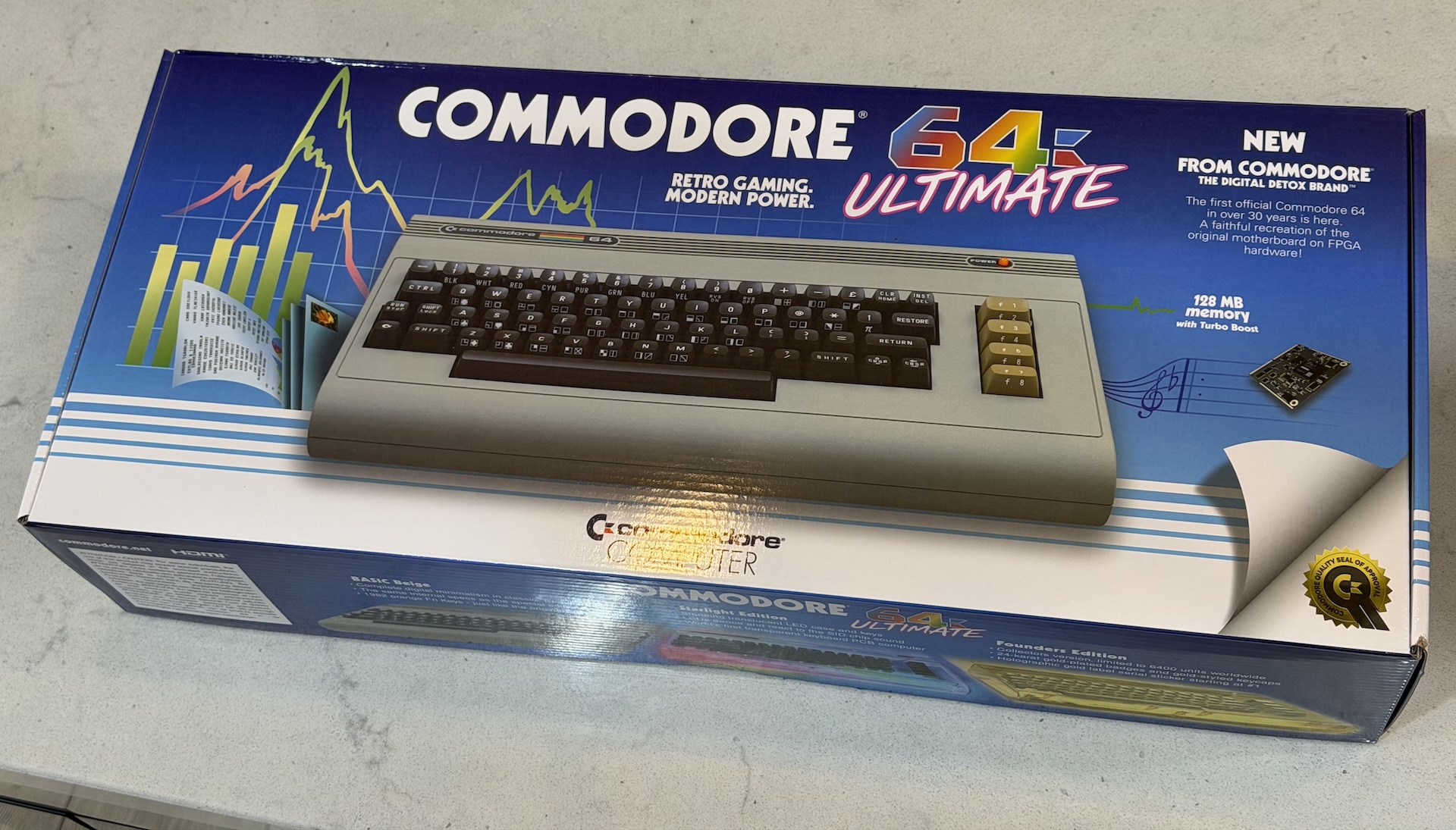
Commodore 64 Ultimate Box
The wait ended around 22 December when (despite still showing as “shipping to local transit hub”) the C64 Ultimate was delivered to my door. That may have been the first time the local Australia Post parcel delivery guy had seen a 52 year old man with a giant man squeal with glee (sorry about that, dude), but I was pretty pleased when I saw the logo on the box he handed over to.
it’s beginning to look a lot like christmas
The original Commodore 64 required either a monitor or an RF-modulator to be able to plug into a regular TV. My first Commodore 64 did not come with either, and so on Xmas day I received a functionally exciting but practically unusable computer that sat unused for a couple of weeks before the local electronics store signalled the RF-modulator we had ordered was ready for pick-up. (That was a very long couple of weeks.)
The Commodore 64 ultimate will apparently work with an original C64 monitor, but more pleasingly comes with standard HDMI – so that wasn’t a problem this time. But, ironically honouring that tradition of getting a C64 at Xmas but not being able to fully use it, the joystick ordered with the Ultimate had not yet been shipped.
time for a reset
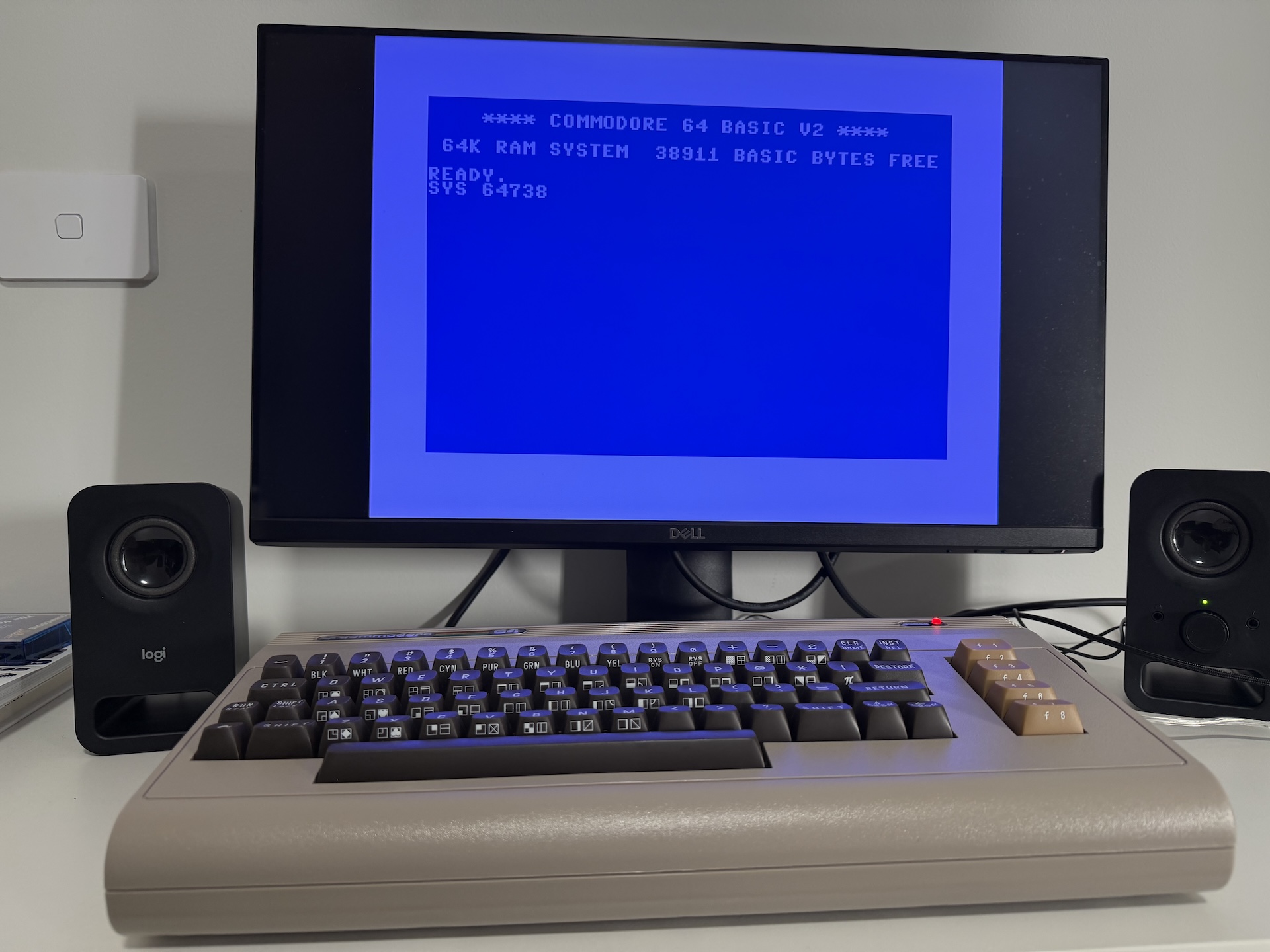
Powered on and ready to reset your world view
There might be a fraction of a second difference between the time it took an original C64 to turn on and the time it takes for the Ultimate to turn on, but it’s so long ago that I turned on an original system that I can’t recall. Flipping the power switch brings up the reassuring and beautiful Commodore 64 BASIC environment, ready to load programs or start typing your own in.
This reminds me – when I see my cardiologist at the end of January I really do need to ask if I’m allowed to go off my anticoagulants in bursts so that I can get a tattoo reading SYS 64738 on the back on my neck. If you’re talking to me around the first half of the last week of January, do give me a nudge and tell me not to forget that.
what the heck is an ethernet?
If you had told me back in the day I had a C64 that one day I’d end up with a more modern C64 which would have ethernet, I’d have looked like you as if you were nuts and asked, “what is ethernet?” My reaction probably would have been even weirder if you’d described WiFi. But the Ultimate has both ethernet and WiFi, allowing you to connect the control environment to hosting environments to download other software.
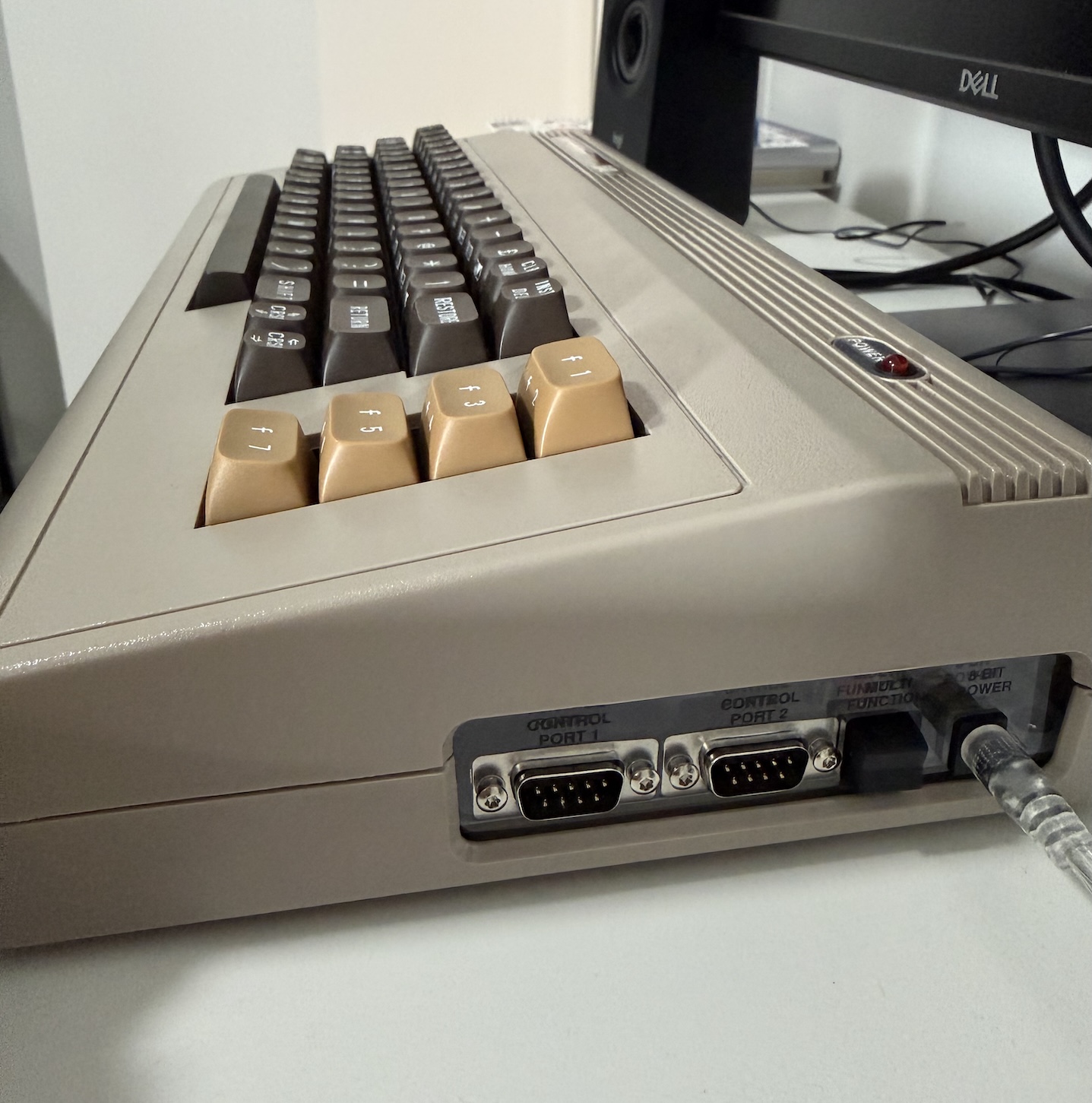
Side view of Commodore 64 Ultimate
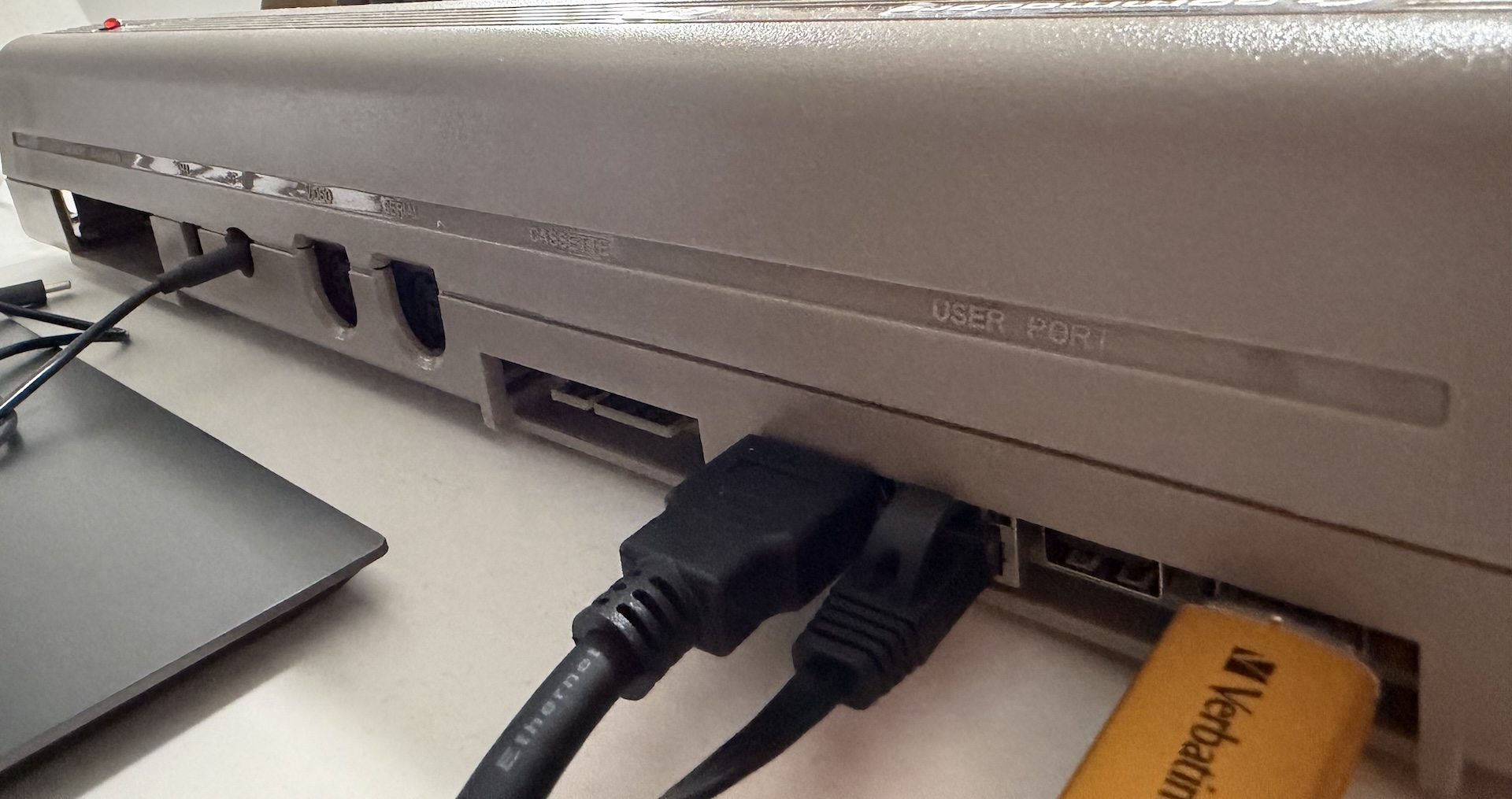
Rear view of Commodore 64 Ultimate
Commodore 64 Ultimate Control Panel
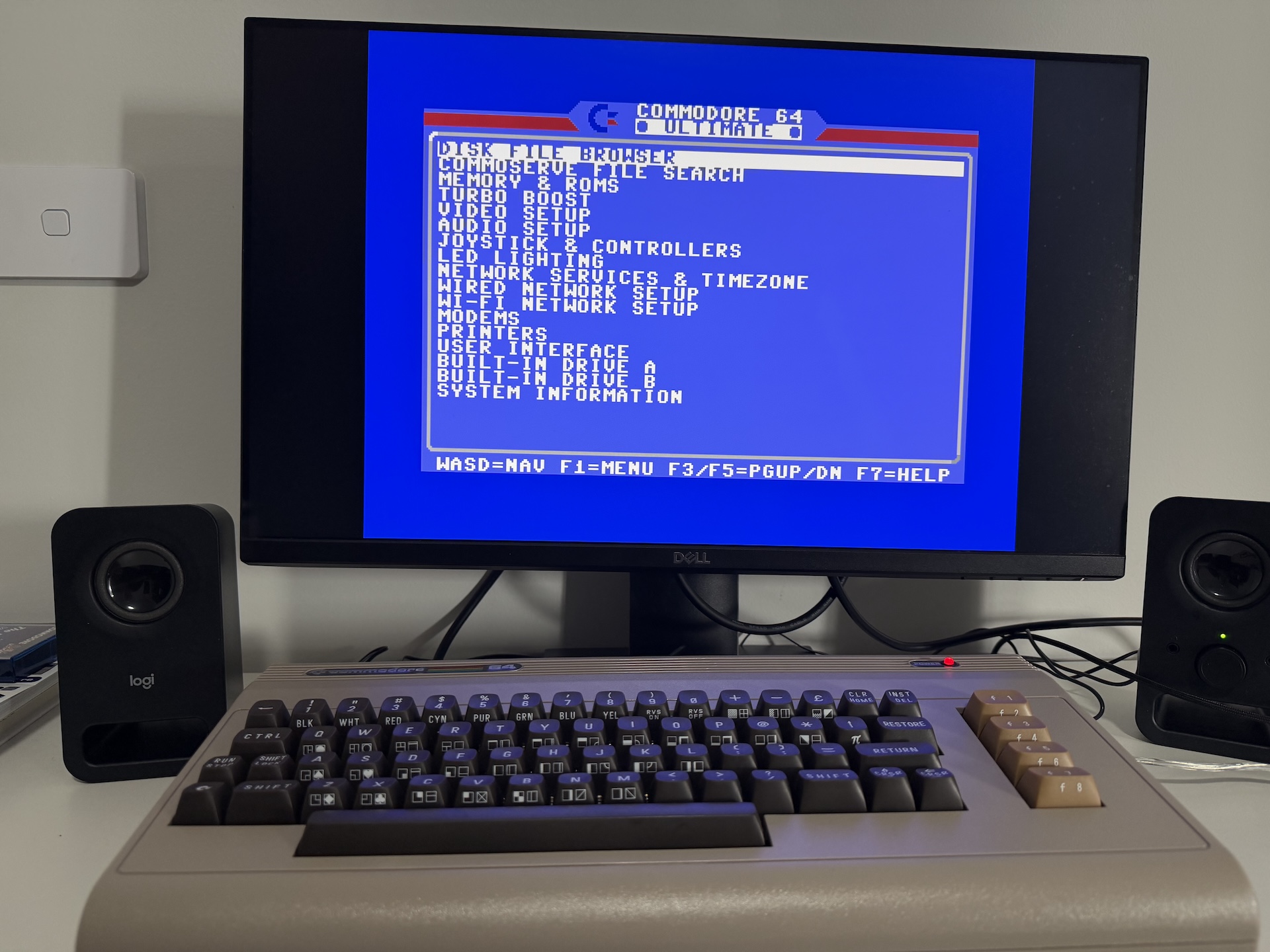
The Ultimate launches into the standard Commodore BASIC environment, but you can bring up the main control panel wrapping around that environment either by pushing up the rocker power switch, or more pleasingly, tapping the combo of the Commodore Key + the RESTORE key. From this menu, you can control the guts of the operating environment, letting you do things such as:
- Browsing disk, tape and cartridge images stored on USB, SD or internal memory.
- Searching for files and media via the CommoServ service provided by Commodore.
- Turning on emulated RAM expansion mode.
- Controlling turbo boost functionality.
- Configuring WiFi or Ethernet access.
- Configuring Joysticks and other controllers.
The joysticks/controller section is perhaps the saving grace given my joystick hasn’t arrived yet — it allows you to enable a primitive but slightly serviceable WASD/return emulation for the 4 directional joystick controls + fire, for either joystick port. I’d perhaps argue that it would have been really nice had the Ultimate supported modern joysticks via USB, but this was not to be – and once my joystick does arrive, I’m not going to mind.
geos? sad preston
My goodness, I cannot tell you how magical GEOS was to me when I was a teenager. We had Apple IIs and before I left, Macs at our high school (including, I must note, the incredibly magical Apple IIgs), but GEOS on the Commodore 64 was my first WIMP and my heart still skips a beat (thankfully figuratively, given afib and all that), when I think of the joy of GEOS.
The Ultimate comes with GEOS, which sadly for me, is not working. It loads to the initial view of a desktop with nothing on it, and never progresses. Given my husband never got to use GEOS (his C64 experience was tape-only), I was looking forward the most to showing him, an art director, GEOS. But so far, alas, this is not to be so – despite trying about every option I can find on the Ultimate for enabling different compatibility modes. So far, it’s been the only true disappointment in the experience. Commodore, if you’re listening, HELP.
compatibility
So far, compatibility for the Ultimate seems to be a dream – other than whatever is happening to me for GEOS.
Jumpman intro screen
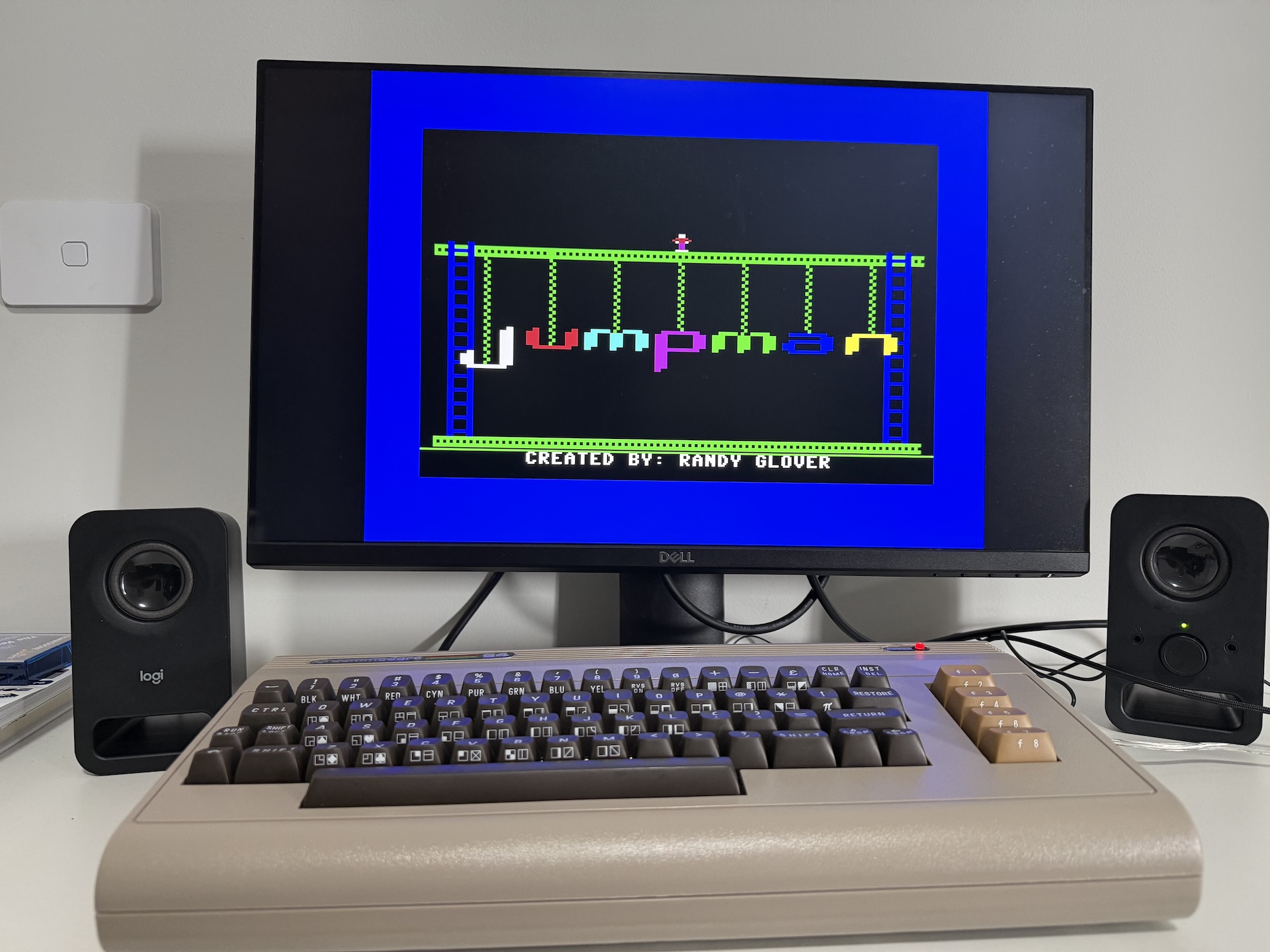
There are a bunch of games, demos and such that come with the Ultimate by default, but it’ll also work with disk and tape images, etc., you’ll find lovingly preserved online. In short: if you dream of the 8-bit era of computing, the Ultimate will likely let you let you realise that dream more completely than just about anything else out there.
The games and programs that come with the Ultimate are a joy of 8-bit exploration, and I’ll be months exploring these gems. A whole bunch of the games in fact that come with the Ultimate are ones I’d always been interested in but never had, myself.
not so final thoughts
Normally I’d end with “final thoughts”, but I will have many, many thoughts on the C64 Ultimate over the days, weeks and months to come. This isn’t just a step into brief bursts of nostalgia, it’s pure, unadulterated joy. It’s the sort of loving recreation of a childhood joy that is faithful and yes, has a commercial element to it, but is absolutely there for all those folk of my generation who grew up using that magnificent piece of hardware.
Now, some might unfairly claim this is a toy computer. A floppy disk image for instance (for the 1541) is just 172 KB. “What can you fit in that?”, a modern programmer might ask. And I’d answer thusly: a hell of a lot more than someone who works in multiple gigabytes of RAM on a daily basis could ever possibly imagine. For me, one of the joys – one of the most important lessons of the 8-bit computing era was this: optimisation. Absolute miracles were worked in software development in the era where RAM sizes were measured in KB. It is, I lament, an under-appreciated art form, these days.
Now if you will excuse me, I think my next book won’t be written in WordPerfect as I’d originally intended, but in the Bank Street Writer.
Disclaimer: All content is the work of the individual and is in no way affiliated with or representative of any employer, past or present.